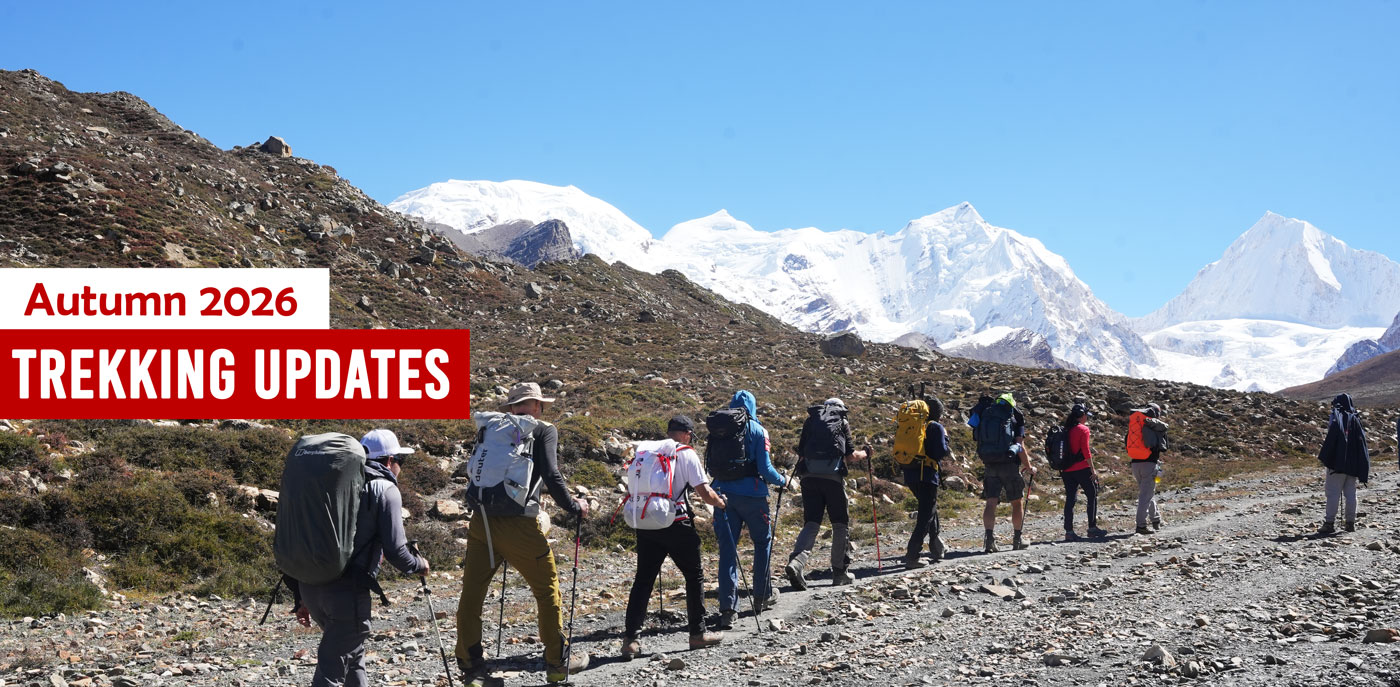
Autumn is the best season for trekking in the Nepal Himalayas for many reasons. Autumn comes just after the monsoon rains. After two to three long months of monsoon rain, the skies begin to become clearer, with blue skies and white dots of clouds. Because of the monsoon rains and hot weather, all the hills and terrace farmlands, as well as the entire landscape of the mid-hills, are covered in beautiful green and yellowish colors. This makes the most beautiful frame of nature.
The Himalayan peaks begin to become visible from a distance in the autumn season, as there is no haze and no clouds between you and the mountain peaks like in winter or the monsoon season.
The temperature in the trekking regions – basically in the lower river basins and gorges – turns out to be the most comfortable, neither too hot nor too cold. The length of daylight is also just perfect. In the winter months, the days are shorter than in autumn. So, we begin this years’ autumn trekking in the Himalayas with excitement, eagerness, and adventure.
We begin this year’s autumn trekking season on August 30, with the first trekking group heading to the Manaslu region, where the monsoon may still be active, possibly influenced by ongoing global warming and climate change.
Manaslu Circuit Trekking (30 Aug-15 Sep, 2026) – Updates
Arrival and Preparation in Kathmandu:
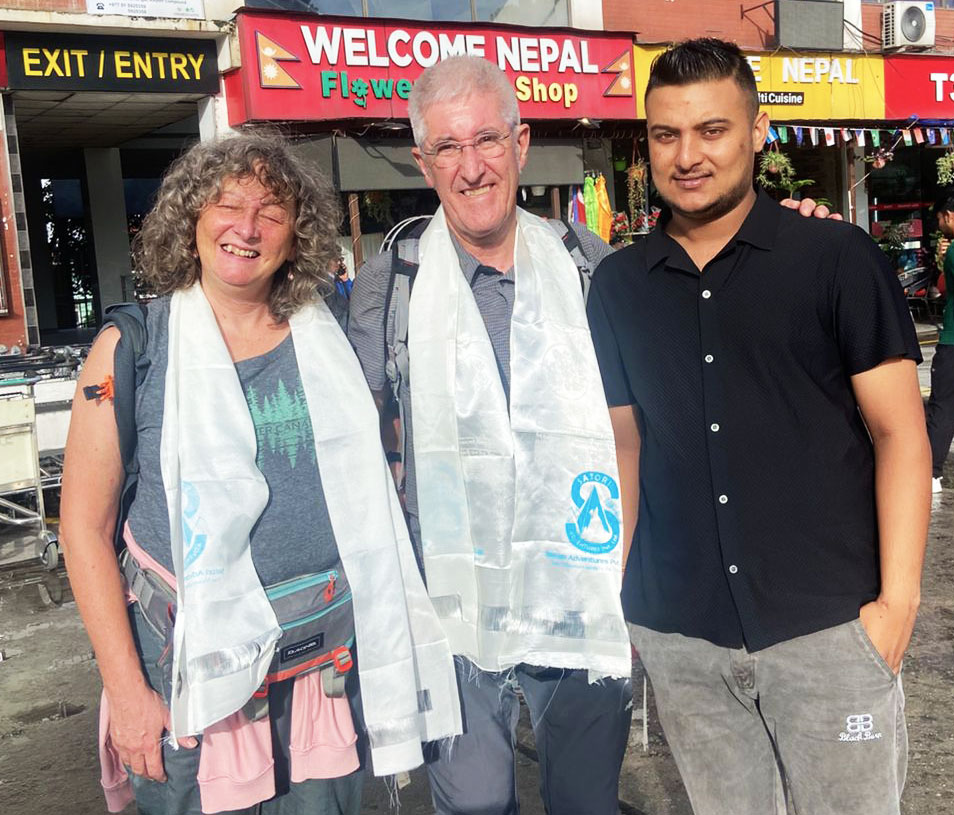
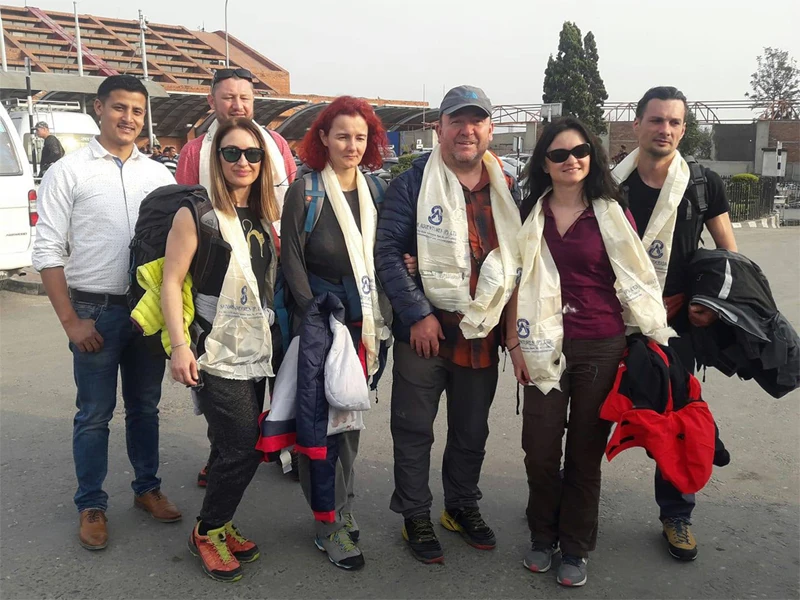
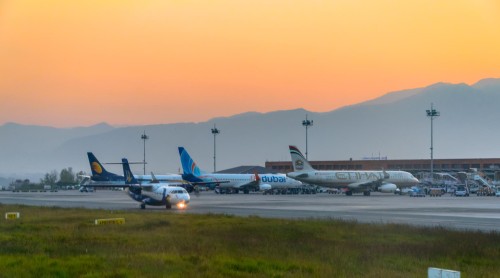
We welcomed our first autumn trekking group, two wonderful trekkers, Luis Otaduy Castillo and Marta Ibarreta Fanlo from Spain, on 30th August 2026 at 06:30 am. They arrived in Nepal with excitement, enthusiasm, and a great sense of adventure.
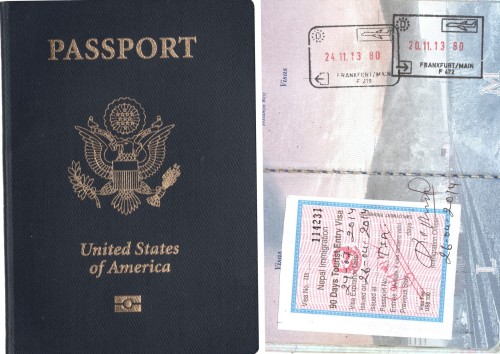
They spent a day in Kathmandu preparing for the journey, participating in the last-minute shopping. And, at the same time we made the essential permits. These includes; Annapurna Conservation Area and Manaslu Conservation Area Permits from the National Trust for Nature Conservation, and the Restricted Area Permit from the Department of Immigration.
To preserve the region’s rich biodiversity and culture close to Tibet, the government treats this region as fragile and restricted to foreign visitors. This means you need a special permit to enter the region.
The Manaslu region trekking has emerged as a popular trekking destination in recent years after Everest, Annapurna, and Langtang. It is a culturally rich and naturally beautiful region to trek, with diverse landscapes, rural villages and farming terraces, age-old monasteries, Tibetan-like culture, and unique day-to-day life of the people. Moreover, the views of the mountain peaks, including the Ganesh Himal range, peaks from the Shringi Himal range, and the Manaslu range, as well as Annapurna, are amazing from various view points along the way.
Trek Starts to Manaslu and Larke La Pass
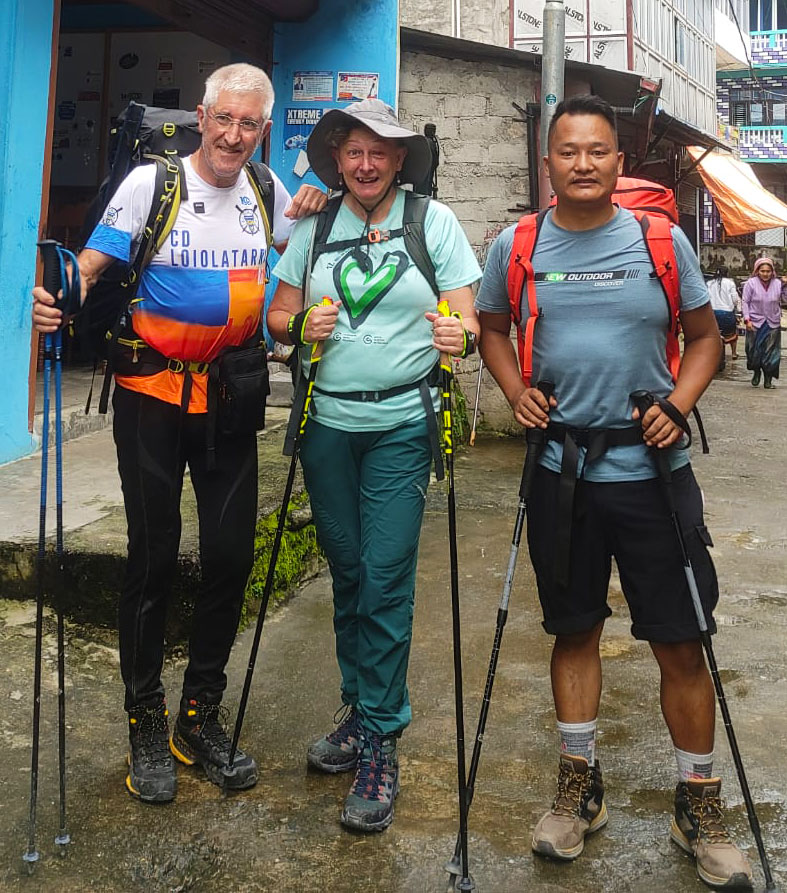
Luis and Marta met with their experienced Guide Ngang Dorji Sherpa, who has more than eighteen years of experience in the Nepal Himalayas with multiple 8,000m, 7,000m, and 6,000m mountain peak climbs and dozens of trekking.
They left Kathmandu early in the morning at 5:00 am in a jeep for Sotikhola, which takes about ten hours to reach the destination. They drove through Gorkha town, the ancient home of the Gorkha king, whose family ruled Nepal for about 240 years and was ousted in 2008.
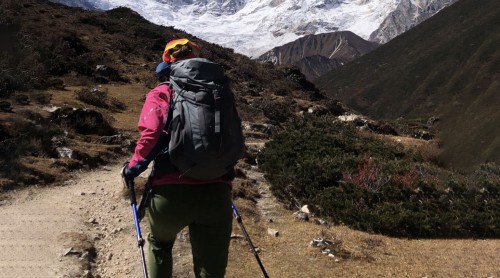
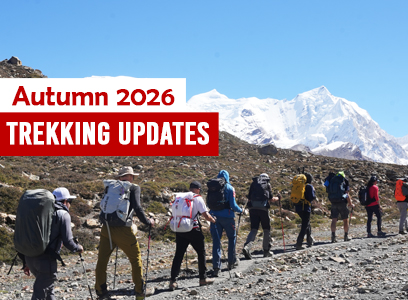
The first trekking day, on 1st September, they began the day with breakfast in the morning at 7:30 am, including chapati, cheese, omelets, and tea. And the walking started at 8.20 am. The trail passes through various villages, green fields, rivers and streams, and beautiful waterfalls. As the monsoon was still active and there were occasional rains, trekkers had to walk through some landslides, and even take off shoes to cross some smaller streams, adding fun and adventure.
At one point, our trekkers had to wear rain ponchos to cross the waterfall that falls onto the trail. Satori Adventures’ seasoned guide, Ngang Dorji Sherpa, with his long experience and patience handled the situations well and help Marta and Luis to trek safely.
Most of the days, the weather remained cloudy, with occasional rain in the late afternoon and showers at night.
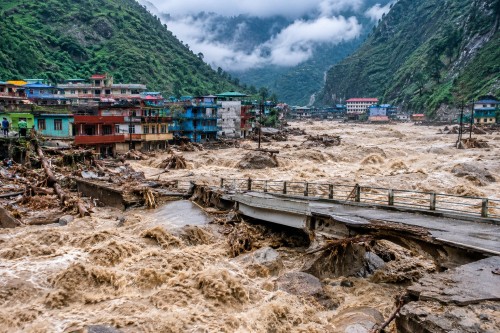
On September 5th, our trekking team walked from Namrung to Syala. The day was cloudy when the trek began in the early morning, but it rained throughout the day from the afternoon. Surprisingly, this rain seriously damaged the trail near Namrung the next day, and the Manaslu Circuit Trek was closed for a few days following the Namrung flood. The flood swept away a few bridges, and the trail was completely cut off. Our trekking team was lucky to cross this place on the same day the damage occurred.
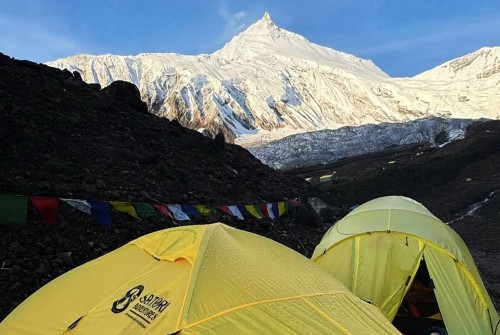
The Samagaon acclimatization and rest day was spent exploring nearby monasteries and the lake. The mountain was covered by clouds almost all the time, but the views of the green pastures, glaciers, and lake, along with the cultural immersion, were amazing to experience.
The Pass: Larke La at 5,106 m (16,752 ft)
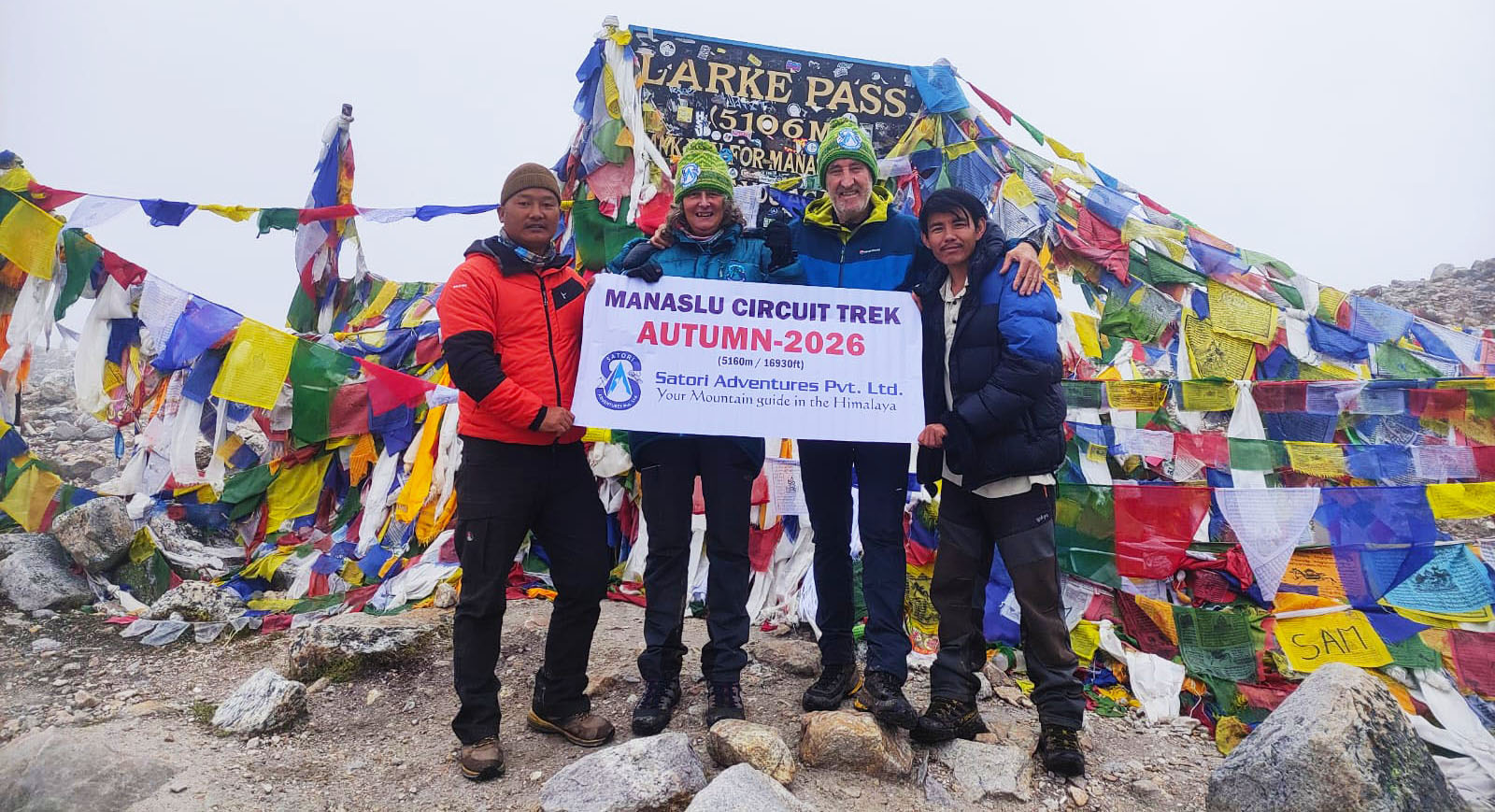
Luis and Marta with guide Ngang Dorji and their helper/porter began the day early in the morning at 03.30 am. With porridge as breakfast, they began the hike at 04.00 am. At 9.00 am they reached the Larke La Pass at 5,106m.
Unfortunately, it rained while they were on the top of the Larke La and they missed the view of the mountain peaks including: Mt. Manaslu (8,163 m), and its subsidiaries, Larke Peak (6,249 m), Himlung Himal (7,126 m), Ratna Chuli (6,703 m), Kang Guru (6,981 m), Nemjung (7,140 m), and Gyaji Kang (7,038 m).
Unfortunately, it rained at the top of Larke La, and our team missed the magnificent panoramic views of the mountain peaks, including Mt. Manaslu (8,163 m) and its subsidiaries, Larke Peak (6,249 m) and Larke North 6,010 m, Himlung Himal (7,126 m), Kang Guru (6,981 m), Nemjung (7,140 m), and others. They could see very brief mountain view from Samagaon, and Bhimthang.
After spending some time in the pass, team descended to Bhimthang which takes about 10 hours in total. It is pretty tiring day as well, and the biggest day of the entire trip.
Completion:
From Bhimthang, our team walked to a small town named Goa, and the next day, they walked for an hour to Tilije/Tilje and then drove by jeep to Besishahar, the gateway town to the Annapurna Circuit Trek. From Besi Sahar on 13th September, 2026 all drove back to Kathmandu.
Guide, Ngang Dorji, reports to us that despite the cloudy weather and frequent rain, the difficulty of walking through landslides, and crossing waterfalls at times, Luis and Marta successfully completed the Manaslu Circuit Trek, which is a moderate-to-hard, high-altitude mountain pass trek. And, they both enjoyed every day, with beautiful waterfalls, rivers, villages, bit of mountain views, and warm local hospitality.
Although the travelers are still skeptical about the recent floods, damage, and travel difficulties, including the flood in Namrung and the closure of the Manaslu Circuit Trek for about three days, the local government has already repaired the route, and Nepal is absolutely travelable, comfortable, and safe in experienced hands to trek and travel. We are waiting for other batch of trekkers to serve in the Nepal Himalayas in this autumn season.